Category: Uncategorized

  • The People’s Choice – ThrowbackMachine.com

    The People’s Choice

    The People’s Choice is an American television situation comedy that aired on NBC from 1955 to 1958, primarily sponsored by The Borden Company.

    It stars Jackie Cooper as Socrates “Sock” Miller, an ex-Marine and a young politician in fictitious New City, California.  Sock has a basset hound named “Cleo”, whose thoughts (voiced by Mary Jane Croft), as she balefully observes Sock’s dilemmas, are recorded on the soundtrack for the viewers’ amusement.  Cleo’s real name was Bernadette. Much of Cleo’s dialog consists of wisecracks.  The popularity of the basset hound breed increased markedly with the run of the show.
    In the first season, Sock is an ornithologist living in a trailer park with his Aunt Gus (Margaret Irving).  A city council member, he is dating Mandy Peoples (Patricia Breslin), the daughter of the mayor (Paul Maxey), who does not entirely approve of the relationship but gradually warms to Sock.

    Later, Sock takes courses (though he is not in law school) to pass the California bar exam to become an attorney, so that he can afford to marry Mandy.  In the first season finale, Sock suddenly proposes to Mandy and wants to elope.  He is afraid the mayor will want to stage a big wedding, and they won’t be able to get married for many months.  The couple drives to Nevada for a quickie wedding, intending to return in time for Sock to take his bar exam.  On the way back, they are arrested for a traffic violation, spend the night in jail, and Sock misses the bar exam.  Sock wants to be independent of his father-in-law; so they agree to keep their marriage a secret from the mayor until Sock gets his law license.

    Most episodes in the second season are about Sock and Mandy trying to be together (as much as this could be depicted in the 1950s), while keeping the mayor from finding out that they are married.  At some point during the season, Aunt Gus and the mayor get married, and she learns that Sock and Mandy are married and agrees to keep their secret from the mayor.  By the end of the season, Sock has passed the bar, and their marriage is out in the open.  Sock’s scheming Marine buddy, Rollo “The Hex” Hexley (Dick Wesson), moved in with Sock during the second season and appeared in twenty-seven episodes as well as the original 1955 pilot.
    In the third season, Sock manages a residential real estate development called “Barkerville Estates.”  They still return to New City often enough for Mayor Peoples and Aunt Gus to appear regularly.
    The series was created and co-produced by Irving Brecher, who was also the creator of the 1949 situation comedy, The Life of Riley. Although The People’s Choice never made the top 30 programs, its ratings were respectable enough to warrant a three-year run on NBC.  The show later became popular in syndication.
  • Gidget – ThrowbackMachine.com

    Gidget

    Gidget is an American situation comedy about a surfing, boy-crazy teenager called “Gidget” and her widowed father Russ Lawrence, a UCLA professor.  Sally Field stars as Gidget with Don Porter as father Russell Lawrence.  The series was first broadcast on ABC from September 15th, 1965 to April 21st, 1966.

    The television series was based upon concepts and characters created by Frederick Kohner in his 1957 novel Gidget, the Little Girl with Big Ideas, which Kohner based upon the adventures of his teenage daughter Kathy.  The novel was adapted into a 1959 movie starring Sandra Dee, James Darren and Cliff Robertson.  The 1965 weekly, half-hour television series is seen by some as a sequel to the 1959 film, despite numerous discontinuities in plot, time frame and other details.  It can also be seen as an independent incarnation, related to but distinct from either the novels or the films. Kohner served as a script consultant on the show.

    The series reintroduced Gidget’s friend Larue and married sister Anne Cooper, both of whom appear in Kohner’s original novel, but are absent from the motion picture series.  Gidget’s brother-in-law, who appears in the novels as the intelligent but condescending child psychiatrist Larry Cooper is reinvented in the television series as John Cooper, an obtuse but lovable psychology student.
    Gidget is about the father-daughter relationship between Frances “Gidget” Lawrence and her widowed father Russell Lawrence.  Episodes follow Gidget’s adventures in school, at home, and at nearby beaches.  Russell Lawrence guides his daughter through her fifteenth year, while married sister Anne and husband John offer often unsolicited child-rearing tips.  Gidget’s friend Larue sometimes takes part in her escapades.  More often than not, Gidget receives moral instruction from her father and gains wisdom from her experiences.
    Each episode is narrated by Gidget; on occasion, she breaks the Fourth wall and directly addresses her audience, usually reflecting on what she has learned from the evening’s story, sometimes ending with “Toodles!” (an expression Field improvised during production).

    Gidget was filmed at the Columbia/Warner Bros. Ranch in Burbank, California, with the exterior and kitchen set borrowed from the Hazel series, which was filming its final season at the time.  The house situated next door to the Lawrence residence is the principal residence on Bewitched series, which was in production simultaneously.
    The show launched the career of 18-year-old Sally Field, who defeated 75 other teenage girls for the title role.  Field exaggerated her surfing experience to the show’s casting directors during her audition (she had none); she later took lessons from Phil Sauers just to be able to pretend to surf for the cameras.  Sauers served as the series’ “Surfing Technical Consultant” and provided the surfboards used during filming of the series.  While the Gidget of the novel and the original film are both blondes, the Gidget of the television series is a brunette.

    The lyrics of the theme song “”(Wait ‘Til You See) My Gidget” were written by Howard Greenfield, with music by Jack Keller.  The song was performed in the pilot by The Four Freshmen, and in the series by Johnny Tillotson.
    Gidget faced stiff competition during its initial run.  The show originally aired on Wednesdays at 8:30 p.m., opposite The Beverly Hillbillies (CBS) and The Virginian (NBC), two established shows with strong ratings.  The series was moved to Thursdays at 8:00 p.m. starting with Episode 18 (“Like Voodoo”) where it performed poorly opposite CBS’s Gilligan’s Island, despite airing after the Top 5-rated Batman.
    ABC cancelled Gidget in April 1966 — just as the show began to find a large teen audience.  Summer reruns launched the show into the Top 10 as viewers looked for programs they had not seen during their original fall/winter broadcasts.  ABC had a belated hit on their hands, but refused to renew the show because they would have to admit they were premature in its cancellation.  In addition, industry practice at the time rarely allowed for cancelled shows to be resurrected.
    Rather than squander their newly found audience which ABC was hurting for at the time, the network scrambled to find a new starring vehicle for Field.  The result was The Flying Nun (1967–70), where Field reluctantly portrayed Sister Bertrille for three seasons.  Field later commented that she has great affection for her young persona and was proud of her work on Gidget but was embarrassed with The Flying Nun.
  • 20th Century Fox Archives – ThrowbackMachine.com

    Room 222

    Room 222

    Room 222 is an American comedy-drama television series produced by 20th Century Fox Television.  The series aired on ABC for 112 episodes from September 17th, 1969 until January 11th, 1974. The series focused on an American history class at the fictional Walt Whitman High School in Los Angeles, California, although it also depicted other events […]

    Land of the Giants

    land of the giants

    Land of the Giants is an hour-long American science fiction television program lasting two seasons beginning on September 22nd, 1968, and ending on March 22nd, 1970. The show was created and produced by Irwin Allen.  Land of the Giants was the fourth of Allen’s science fiction TV series.  The show was aired on ABC and […]

    The Time Tunnel

    the time tunnel

    The Time Tunnel is a 1966–1967 U.S. color science fiction TV series, written around a theme of time travel adventure. The show was creator-producer Irwin Allen’s third science fiction television series, released by 20th Century Fox and broadcast on ABC. The show ran for one season of 30 episodes. Project Tic-Toc is a top secret […]

    The Long, Hot Summer

    The Long, Hot Summer

    The Long, Hot Summer is an American drama series from 20th Century Fox Television that was broadcast on ABC-TV for one season from 1965-1966.  Created by Dean Riesner, The Long, Hot Summer was based on the novel The Hamlet by William Faulkner, the short story “Barn Burning”, and the 1958 film of the same name. […]

    Lost in Space

    lost in space

    Lost in Space is an American science fiction television series created and produced by Irwin Allen, filmed by 20th Century Fox Television, and broadcast on CBS.  The show ran for three seasons, with 83 episodes airing between September 15th, 1965, and March 6th, 1968. Though the original television series concept centered on the Robinson family, […]

    Daniel Boone

    Daniel Boone

    Daniel Boone is an American action-adventure television series starring Fess Parker as Daniel Boone that aired from September 24th, 1964 to September 10th, 1970 on NBC for 165 episodes, and was made by 20th Century Fox Television. Ed Ames co-starred as Mingo, Boone’s Cherokee friend, for the first four seasons of the series.  Albert Salmi […]

    Voyage to the Bottom of the Sea

    voyage to the bottom of the sea

    Voyage to the Bottom of the Sea is a 1960s American science fiction television series based on the 1961 film of the same name.  Both were created by Irwin Allen. Voyage to the Bottom of the Sea was the first of Irwin Allen’s four science fiction television series, as well as the longest running.  It […]

  • Tuesday Archives – ThrowbackMachine.com

    The Doris Day Show

    The Doris Day Show

    The Doris Day Show is an American sitcom that was originally broadcast on the CBS Television network from September 1968 until March 1973, remaining on the air for five seasons and 128 episodes. The Doris Day Show was also the title of her radio show which aired from Hollywood in 1952, with “It’s Magic” as […]

    The Mod Squad

    The Mod Squad

    A “hippie” undercover cop show that ran on ABC from September 24th, 1968, until August 23rd, 1973.   It starred Michael Cole as Pete Cochran, Peggy Lipton as Julie Barnes, Clarence Williams III as Linc Hayes, and Tige Andrews as Captain Adam Greer.  The executive producers of the series were Aaron Spelling and Danny Thomas. They were The Mod Squad (“One black, one white, one blond”), the hippest and first young undercover […]

    Lancer

    Lancer

    Lancer is an American Western series that aired on CBS from September 1968, to May 1970.  Lancer lasted for fifty-one hour-long episodes shot in color.  The series stars Andrew Duggan, James Stacy, and Wayne Maunder as a father with two half-brother sons, an arrangement similar to the more successful Bonanza on NBC. Duggan stars as […]

    Julia

    Julia

    Julia is an American sitcom notable for being one of the first weekly series to depict an African American woman in a non-stereotypical role.  Previous television series featured African American lead characters, but the characters were usually servants.  The show stars actress and singer Diahann Carroll, and ran for 86 episodes on NBC from September 17th, 1968 to March 23rd, 1971. The series was produced […]

    My Mother the Car

    My Mother the Car

    My Mother the Car is an American fantasy sitcom which aired for a single season on NBC between September 14th, 1965 and April 5th, 1966.  A total of 30 episodes were produced by United Artists Television. Critics and adult viewers generally panned the show, often savagely.  My Mother the Car was an original variation on […]

    Hullabaloo

    Hullabaloo

    Hullabaloo is an American musical variety series that ran on NBC from January 12th, 1965 through August 29th, 1966.  Similar to Shindig! it ran in prime time in contrast to ABC’s American Bandstand. Directed by Steve Binder, who went on to direct Elvis Presley’s ’68 Comeback Special, Hullabaloo served as a big-budget, quality showcase for […]

    The Man From U.N.C.L.E.

    The Man From U.N.C.L.E.

    The Man from U.N.C.L.E. is an American television series that was broadcast on NBC from September 22nd, 1964, to January 15th, 1968.  It follows the exploits of two secret agents, played by Robert Vaughn and David McCallum, who work for a fictitious secret international espionage and law-enforcement agency called U.N.C.L.E. Originally co-creator Sam Rolfe wanted […]

    World War One

    World War One

    World War One is an American documentary television series that was shown on CBS during the 1964–1965 television season to commemorate the fiftieth anniversary of the start of the war.  The series was produced by CBS News, which featured 26 half-hour episodes, was narrated by Robert Ryan. World War One originally aired on Tuesday nights […]

    Peyton Place

    Peyton Place

    Peyton Place is an American prime-time soap opera which aired on ABC in half-hour episodes from September 15th, 1964 to June 2nd, 1969. Based upon the 1956 novel of the same name by Grace Metalious, the series was preceded by a 1957 film adaptation.  A total of 514 episodes were broadcast, in black-and-white from 1964 […]

    The Tycoon

    The Tycoon

    The Tycoon is a 32-episode American situation comedy television series broadcast by ABC.  It starred Walter Brennan as the fictitious businessman Walter Andrews, similar to his birth name of Walter Andrew Brennan.  The series aired with new episodes at 9 p.m. Eastern time Tuesday from September 15th, 1964, until April 27th, 1965.  It continued in […]

    Huntley – Brinkley Report

    The Huntley Brinkley Report

    The Huntley-Brinkley Report (sometimes known as The Texaco Huntley-Brinkley Report, for one of its early sponsors) was the NBC television network’s flagship evening news program from October 29th, 1956, until July 31st, 1970.  It was anchored by Chet Huntley in New York City, and David Brinkley in Washington, D.C.  It succeeded the Camel News Caravan, […]

    The Golden Touch of Frankie Carle

    The Golden Touch of Frankie Carle

    The Golden Touch of Frankie Carle was a short-lived musical variety television series broadcast in the United States by NBC from August to October 1956.  The Golden Touch of Frankie Carle featured the pianist and guest singers performing a variety of music, including popular standards and the current hits of the day. The program’s main […]

    The Kaiser Aluminum Hour

    Kaiser Aluminum Hour

    The Kaiser Aluminum Hour is a dramatic anthology television series which was broadcast in prime time in the United States during the 1956-57 season by NBC.  The Kaiser Aluminum Hour was shown on alternate Tuesday nights at 9:30 pm Eastern time in rotation with the longer-running Armstrong Circle Theatre, with the first broadcast airing on July 3rd, 1956 and the final one on June […]

    Alfred Hitchcock Presents

    Alfred Hitchcock Presents

    Alfred Hitchcock Presents is an American television anthology series hosted by Alfred Hitchcock.  The series featured dramas, thrillers, and mysteries.  By the time the show premiered on October 2nd, 1955, Hitchcock had been directing films for over three decades. Alfred Hitchcock Presents is well known for its title sequence.  The camera fades in on a simple line-drawing caricature of Hitchcock’s rotund […]

    The Phil Silvers Show

    The Phil Silvers Show

    The Phil Silvers Show, originally titled You’ll Never Get Rich, was a situation comedy which ran on CBS from 1955 to 1959 for 142 episodes, plus a 1959 special.  The series starred Phil Silvers as Master Sergeant Ernest G. Bilko of the United States Army. The series was created and largely written by Nat Hiken, and won three consecutive Emmy Awards for Best Comedy Series.  The show […]

    Navy Log

    navylog

    Navy Log is an American drama anthology series that initially aired for one season on CBS. It relates the greatest survival war stories in the history of the United States Navy. This series premiered on September 20th, 1955, but the following year, it was moved to ABC, where it aired until September 25th, 1958. The […]

    Warner Brothers Presents

    Warner Brothers Presents

    Warner Bros. Presents is the umbrella title for three series telecast as part of the 1955-56 season on ABC: Cheyenne, a new Western series that originated on Presents, and two based on classic Warner Bros. films, Casablanca and Kings Row. At first, Warner Bros., like most other Hollywood studios, had seen television as a threat that it wished would disappear. Jack Warner tried to dismiss it as a mere passing fad, but by […]

    The Life and Legend of Wyatt Earp

    lifelegendwyattearp

    The Life and Legend of Wyatt Earp is a western television series loosely based on the life of frontier marshal Wyatt Earp. The half-hour black-and-white program aired for 229 episodes on ABC from 1955 to 1961 and featured Hugh O’Brian in the title role. O’Brian was chosen for the role in part because of his […]

    John Charles Daly and the News

    John Charles Daly and the News

    John Charles Patrick Croghan Daly (generally known as John Charles Daly or simply John Daly (February 20th, 1914 – February 24th, 1991) was an American journalist, game show host and radio personality, probably best known for hosting the panel show What’s My Line?.  He was the vice president of ABC during the 1950s.  On December […]

    Talent Varieties

    255px-Talent_Varieties_set (1)

    Talent Varieties is a country music talent show on American network television and radio in 1955 that featured performers hoping to achieve fame in the entertainment business.The weekly ABC-TV program was a live half-hour summer replacement series hosted by Slim Wilson. Wilson introduced the amateur and professional talent, including music and comedy acts (many from the Ozarks); and his Tall Timber Trio, composed of Speedy Haworth (guitar), Bob White (bass […]

  • High Finance – ThrowbackMachine.com

    High Finance

    High Finance is a quiz show created and hosted by Dennis James which aired on CBS from July 7th to December 15th, 1956.  It followed Gunsmoke on the CBS schedule.  High Finance aired at 10:30 p.m. Saturdays opposite NBC’s Your Hit Parade.

    On the program, contestants answered questions about current events.  The player would be asked five questions based on three newspapers which he or she studied before the show.  Each correct answer earned $300.  Three correct answers allowed the player to play the “investment segment” in which he or she wagered any amount of the money won on answering a question.  A correct answer won the wager and a prize, plus the option to risk any prizes won and return the next week to play another “investment segment” or keep any prizes won and leave the show.  A fourth win would earn that player his or her “dream prize”, such as a miniature golf course or a restaurant.  A fifth successful “investment segment” won that player an additional $75,000.
  • MGM Parade – ThrowbackMachine.com

    MGM Parade

    MGM Parade is the title of a documentary television series produced by Metro-Goldwyn-Mayer and broadcast by the ABC network during the 1955-56 season on Wednesdays at 8:30pm (E.S.T.), under the alternate sponsorship of American Tobacco (Pall Mall), and General Foods (Instant Maxwell House).

    Hosted by George Murphy (September 14th, 1955 – March 7th, 1956), Walter Pidgeon (March 14th – May 2nd, 1956) and other MGM stars, the series went into the MGM vaults to offer segments extracted from such past productions as Good News (1947) and The Pirate (1948); in December, a condensed edition of the 1938 version of A Christmas Carol was presented for the first time on television.  Exploring the inner workings of the MGM studios, it featured interviews with prominent MGM actresses and actors to promote current and upcoming releases.  The program also presented edited “selected short subjects” from the studio’s library (Carey Wilson’s Miniatures, John Nesbitt’s Passing Parade, Pete Smith’s Specialties, Robert Benchley, Tex Avery’s cartoons, et al.).  After Walter Pidgeon became the host, the format was slightly altered to include edited multi-part versions of “classic” MGM feature films, including Captains Courageous and The Pirate, as well as a biography of Greta Garbo.

  • 1950s – ThrowbackMachine.com

    1950s


    The Niteteen Fifties
     The 1950s were about more than just poodle skirts and rock and roll.
    “America at this moment,” said the former British Prime Minister Winston Churchill in 1945, “stands at the summit of the world.”
    During the 1950s, it was easy to see what Churchill meant.  The United States was the world’s strongest military power.  Its economy was booming, and the fruits of this prosperity – new cars, suburban houses and other consumer goods were available to more people than ever before.
    The booming prosperity of the 1950s helped to create a widespread sense of stability, contentment and consensus in the United States.

    Popular Culture

    Music

    Popular music in the early 1950s was essentially a continuation of the crooner sound of the previous decade.  Frank Sinatra, Tony Bennett, Frankie Laine, Patti Page, Judy Garland, Johnnie Ray, Kay Starr, Perry Como, Bing Crosby, Rosemary Clooney, Dean Martin, Georgia Gibbs, Eddie Fisher, Teresa Brewer, Dinah Shore, Kitty Kallen, Joni James, Peggy Lee, Julie London, Toni Arden, June Valli, Doris Day, Arthur Godfrey, Tennessee Ernie Ford, Guy Mitchell, Nat King Cole, and vocal groups like The Mills Brothers, The Ink Spots, The Four Lads, The Four Aces, The Chordettes, Fontane Sisters, The Hilltoppers and The Ames Brothers.  Jo Stafford’s You Belong To Me was the #1 song of 1952 on the Billboard Top 100 chart.
    The middle of the decade saw a sudden, volcanic change in the popular music landscape as classic pop was swept off the charts by rock-and-roll.  Crooners such as Eddie Fisher, Perry Como and Patti Page, who had dominated the first half of the decade, found their access to the pop charts significantly curtailed by the decade’s end.  Doo Wop entered the pop charts in the 1950s.  Its popularity soon spawns the parody “Who Put the Bomp.”  Novelty songs come into popularity, such as “Beep Beep.”
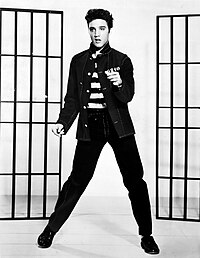
    In the mid-1950s Elvis Presley became the leading figure of the newly popular sound of Rock-n-Roll.
    Rock-n-Roll emerged in the mid-50s with Sam Cooke, Jackie Wilson, Gene Vincent, Chuck Berry, Fats Domino, Little Richard, James Brown, Bo Diddley, Buddy Holly, Bobby Darin, Ritchie Valens, Duane Eddy, Eddie Cochran, Brenda Lee, Bobby Vee, Connie Frances, Johnny Mathis, Neil Sedaka, Pat Boone and Ricky Nelson being notable exponents. In the mid-1950s, Elvis Presley became the leading figure of the newly popular sound of Rock-n-Roll with a series of network television appearances and chart-topping records.  Chuck Berry, with “Maybellene” (1955), “Roll over Beethoven” (1956), “Rock and Roll Music” (1957) and “Johnny B. Goode” (1958), refined and developed the major elements that made Rock-n-Roll distinctive, focusing on teen life and introducing guitar solos and showmanship that would be a major influence on subsequent rock music.  Bill Haley, Jerry Lee Lewis, the Everly Brothers, Carl Perkins, Johnny Cash, Conway Twitty, Johnny Horton, and Marty Robbins were Rockabilly musicians.  Doo Wop was another popular genre at the time.  Popular Doo Wop and Rock-n-Roll bands of the mid to late 1950s include The Platters, The Flamingos, The Dells, The Silhouettes, Frankie Lymon and The Teenagers, Little Anthony & The Imperials, Danny and the Juniors, The Coasters, The Drifters, The Del-Vikings and Dion and the Belmonts to name a few.
    The new music differed from previous styles in that it was primarily targeted at the teenager market, which became a distinct entity for the first time in the 1950s as growing prosperity meant that young people did not have to grow up as quickly or be expected to support a family.  Rock-n-Roll proved to be a difficult phenomenon for older Americans to accept and there were widespread accusations of it being a communist-orchestrated scheme to corrupt the youth.
    Jazz stars in the 1950s who came into prominence in their genres called Bebop, Hard Bop, Cool Jazz and the Blues, at this time included Lester Young, Ben Webster, Charlie Parker, Dizzy Gillespie, Miles Davis, John Coltrane, Thelonious Monk, Charles Mingus, Art Tatum, Bill Evans, Ahmad Jamal, Oscar Peterson, Gil Evans, Jerry Mulligan, Cannonball Adderley, Stan Getz, Chet Baker, Dave Brubeck, Art Blakey, Max Roach, the Miles Davis Quintet, the Modern Jazz Quartet, Ella Fitzgerald, Ray Charles, Sarah Vaughn, Dinah Washington, Nina Simone, and Billie Holiday.
    The American folk music revival became a phenomenon in the United States in the 1950s to mid-1960s with the initial success of the Weavers who popularized the genre. Their sound, and their broad repertoire of traditional folk material and topical songs inspired other groups such as the Kingston Trio, the Chad Mitchell Trio, The New Christy Minstrels, and the “collegiate folk” groups such as The Brothers Four, The Four Freshmen, The Four Preps, and The Highwaymen.  All featured tight vocal harmonies and a repertoire at least initially rooted in folk music and topical songs.
    Mason City Globe-Gazette headline
    On February 3rd, 1959, a chartered airplane transporting three rock’n’roll musicians, Buddy Holly, Ritchie Valens and J. P. “The Big Bopper” Richardson goes down in foggy conditions near Clear Lake, Iowa, killing all four occupants on board, including pilot Roger Peterson.  The tragedy is later termed “The Day the Music Died”, popularized in Don McLean’s 1972 song “American Pie”.  This event, combined with the conscription of Elvis into the US Army, is often taken to mark the point where the era of 50s Rock’n’Roll ended.

    Film

    Cary Grant as Roger O. Thornhill in North by Northwest (1959)

    European cinema experienced a renaissance in the ’50s following the deprivations of World War II.  Italian director Federico Fellini won the first foreign language film Academy Award with La strada and garnered another Academy Award with Nights of Cabiria.  In 1955, Swedish director Ingmar Bergman earned a Jury Prize at the Cannes Film Festival with Smiles of a Summer Night and followed the film with masterpieces The Seventh Seal and Wild Strawberries.  Jean Cocteau’s Orphée, a film central to his Orphic Trilogy, starred Jean Marais and was released in 1950.  French director Claude Chabrol’s Le Beau Serge is now widely considered the first film of the French New Wave.  Notable European film stars of the period include Brigitte Bardot, Sophia Loren, Marcello Mastroianni, Max von Sydow, and Jean-Paul Belmondo.
    Japanese cinema reached its zenith with films from director Akira Kurosawa including Rashomon, Ikiru, Seven Samurai, Throne of Blood, and The Hidden Fortress.  Other distinguished Japanese directors of the period were Yasujiro Ozu and Kenji Mizoguchi.  Russian fantasy director Aleksandr Ptushko’s mythological epics Sadko, Ilya Muromets, and Sampo were internationally acclaimed as was Ballad of a Soldier, a 1959 Soviet film directed by Grigori Chukhrai.
    In Hollywood, the epic Ben-Hur grabbed a record eleven Academy Awards in 1959 and its success gave a new lease of life to Hollywood Studio MGM.
    The “Golden Era” of 3-D cinematography transpired during the 1950s.


    Television

    The 1950s are known as The Golden Age of Television by some people.  Sales of  TV sets rose tremendously in the 1950s and by 1950 4.4 million families in America had a television set.  Americans devoted most of their free time to watching television broadcasts.  People spent so much time watching TV, that movie attendance dropped and so did the number of radio listeners.  Television revolutionized the way Americans see themselves and the world around them.  TV affects all aspects of American culture.  “Television affects what we wear, the music we listen to, what we eat, and the news we receive.”


    Art Movements

    In the early 1950s Abstract expressionism and artists Jackson Pollock and Willem de Kooning were enormously influential.  However by the late 1950s Color Field painting and Barnett Newman and Mark Rothko’s paintings became more in focus to the next generation.
    Pop Art used the iconography of television, photography, comics, cinema and advertising.  With its roots in dadaism, it started to take form towards the end of the 1950s when some European artists started to make the symbols and products of the world of advertising and propaganda the main subject of their artistic work.  This return of figurative art, in opposition to the abstract expressionism that dominated the aesthetic scene since the end of World War II was dominated by Great Britain until the early 1960s when Andy Warhol, the most known artist of this movement began to show Pop Art in galleries in the United States.


    Technology

    Operation Castle became the highest-yield nuclear test series ever conducted by the United States.
    • Charles H. Townes builds the Maser in 1953 at the Columbia University.
    • The Soviet Union launches Sputnik 1, the first artificial satellite to orbit the earth on October 4, 1957.
    • The United States conducts its first hydrogen bomb explosion test.
    • The invention of the modern Solar cell.
    • Passenger jets enter service.
    • The U.S uses Federal prisons, mental institutions and pharmalogical testing volunteers to test drugs like LSD and chlorpromazine. Also started experimenting with the transorbital lobotomy.

    Science

    • Francis Crick and James Watson discover the double-helix structure of DNA. Rosalind Franklin contributed to the discovery of the double helix structure.
    • An immunization vaccine is produced for polio.
    • The first successful ultrasound test of the heart activity.
    • The CERN is established.
    • The world’s first nuclear power plant is opened in Obninsk near Moscow.
    • NASA is organized.
    • President Harry S. Truman inaugurated transcontinental television service on September 4, 1951 when he made a speech to the nation. AT&T carried his address from San Francisco and it was viewed from the west coast to the east coast at the same time.
    • The first human cancer cells were cultured outside of a body in 1951, From Henrietta Lacks, the cells are known as the immortal cells.
  • Circus Boy – ThrowbackMachine.com

    Circus Boy

    Circus Boy is an American action/adventure/drama series that aired in prime time on NBC, and then on ABC, from 1956 to 1958.  It was then rerun by NBC on Saturday mornings, from 1958 to 1960.

    Set in the late 1890s, the title of the series refers to a boy named Corky.  After his parents, “The Flying Falcons,” were killed in a trapeze accident, young Corky (Micky Dolenz – billed at the time as Mickey Braddock) was adopted by Joey the Clown (Noah Beery, Jr.), and the whole Burke and Walsh Circus family.
    The young boy quickly found a role with the circus as water boy to Bimbo, a baby elephant whom Corky would come to consider his pet.  Riding Bimbo’s back, Corky dealt with adolescent problems, and helped the show’s adults including Joey, owner/promoter Big Tim Champion (Robert Lowery), and head canvasman Pete (Guinn Williams), keep the circus successful as the traveling show moved from town to town each week.
  • Grand Ole Opry – ThrowbackMachine.com

    Grand Ole Opry

    The Grand Ole Opry started as the WSM Barn Dance in the new fifth-floor radio studio of the National Life & Accident Insurance Company in downtown Nashville on November 28th, 1925.  On October 18th, 1925, management began a program featuring “Dr. Humphrey Bate and his string quartet of old-time musicians.”  On November 2nd, WSM hired long-time announcer and program director George D. “Judge” Hay, an enterprising pioneer from the National Barn Dance program at WLS in Chicago, who was also named the most popular radio announcer in America as a result of his radio work with both WLS and WMC in Memphis, Tennessee.  Hay launched the WSM Barn Dance with 77-year-old fiddler Uncle Jimmy Thompson on November 28th, 1925, which is celebrated as the birth date of the Grand Ole Opry.

    One hour of the Opry was nationally-broadcast by the NBC Red Network from 1939 to 1956; for much of its run, it aired one hour after the program that had inspired it, National Barn Dance. The NBC segment, originally known by the name of its sponsor, The Prince Albert Show, was first hosted by Acuff, who was succeeded by Red Foley from 1946 to 1954.
    From October 15th, 1955 to September 1956, ABC-TV aired a live, hour-long television version once a month on Saturday nights (sponsored by Ralston-Purina), pre-empting one hour of the then-90-minute Ozark Jubilee.  From 1955–57, Al Gannaway owned and produced both The Country Show and Stars of the Grand Ole Opry, filmed programs syndicated by Flamingo Films.
    Top-charting country music acts performed during the Ryman years, including Roy Acuff, called the King of Country Music, Hank Williams, Webb Pierce, Faron Young, Martha Carson, Lefty Frizzell, and many others.


  • 1958 Archives – Page 2 of 3 – ThrowbackMachine.com

    People are Funny

    People Are Funny

    People Are Funny is an American radio and television game show, created by John Guedel that remained popular throughout the 1940s and 1950s.  The program ran from 1942 to 1960. The program’s stunts and audience participation were calculated to reveal the humorous side of human nature.  After contestants were sent from the studio to perform […]

    Lassie

    Lassie

    Lassie is an American television series that follows the adventures of a female Rough Collie dog named Lassie and her companions, human and animal. The show was the creation of producer Robert Maxwell and animal trainer Rudd Weatherwax and was televised from September 12th, 1954, to March 24th, 1973. The show chalked up seventeen seasons […]

    The Big Picture

    The Big Picture

    The Big Picture is an American documentary television program which aired on ABC-TV from 1951 to 1964.  The series consisted of documentary films produced by the United States Army Signal Corps Army Pictorial Service, showing weaponry, battles, and biographies of famous soldiers. The half-hour weekly program featured famous or before-they-were-famous actors and actresses in quality […]

    Person to Person

    Person to Person

    Person to Person is a popular television program in the United States that originally ran from 1953 to 1961.  Edward R. Murrow hosted it until 1959, interviewing celebrities in their homes from a comfortable chair in his New York studio (his opening: “Good evening, I’m Ed Murrow. And the name of the program is ‘Person to Person’. It’s all […]

    Make Room For Daddy

    Make Room For Daddy

    The Danny Thomas Show (known as Make Room for Daddy during the first three seasons) is an American sitcom which ran from 1953-1957 on ABC and from 1957-1964 on CBS.  A revival series known as Make Room for Granddaddy aired on ABC from 1970-1971. In March 1953, Danny Thomas first signed the contract for the show with ABC and chose Desilu Studios to film it using its three-camera method.  […]

    The United States Steel Hour

    The United States Steel Hour

    The United States Steel Hour is an anthology series which brought hour-long dramas to television from 1953 to 1963.  The television series and the radio program that preceded it were both sponsored by the United States Steel Corporation.  The series originated on radio in the 1940s as Theatre Guild on the Air. The television version […]

    General Electric Theater

    General Electric Theater

    General Electric Theater is an American anthology series hosted by Ronald Reagan that was broadcast on CBS radio and television.  The series was sponsored by General Electric’s Department of Public Relations. The television version of the program, produced by MCA-TV / Revue, was broadcast every Sunday evening at 9:00pm, EST, beginning February 1st, 1953, and […]

    Name That Tune

    Name That Tune

    Name That Tune is an American television game show that put two contestants against each other to test their knowledge of songs.  Premiering in the United States on NBC Radio in 1952, the show was created and produced by Harry Salter and his wife Roberta.  Name That Tune ran from 1953 to 1959 on NBC and CBS in prime time. The first hosts were Red Benson […]

    The Adventures of Ozzie and Harriet

    The Adventures of Ozzie and Harriet is an American situation comedy, airing on ABC from October 3rd, 1952 through March 26th, 1966, starring the real life Nelson family. After a long run on radio, the show was brought to television where it continued its success, running on both radio and television for a few years.  […]

    This is Your Life

    This Is Your Life

    This Is Your Life was an American documentary series broadcast on NBC radio 1948 to 1952, and on NBC television 1952 to 1961.  It was originally hosted by its producer Ralph Edwards. In the show, the host surprises a guest, and proceeds to take them through their life in front of an audience, including special […]

    Masquerade Party

    Masquerade Party

    Masquerade Party is an American television game show.  During its original run from 1952–1960, the show appeared at various times on all three major networks except DuMont (ABC, NBC, and CBS).  A syndicated revival was produced for one season in 1974-75. A panel of celebrities met with another celebrity that was in heavy make-up and/or costume; this disguise would always […]

    I’ve Got a Secret

    I’ve Got a Secret is a panel game show produced by Mark Goodson and Bill Todman for CBS television.  Created by comedy writers Allan Sherman and Howard Merrill, it was a derivative of Goodson-Todman’s own panel show What’s My Line?.  Instead of celebrity panelists trying to determine a contestant’s occupation, the panel tries to determine a contestant’s “secret”: something that is unusual, amazing, embarrassing, or humorous about that person. The […]

    Dragnet

    Dragnet

         “Ladies and Gentlemen:   The story you are about to hear is true.  The names have been changed to protect the innocent.” Dragnet is an American radio, television and motion picture series, enacting the cases of a dedicated Los Angeles police detective, Sergeant Joe Friday, and his partners.  The show takes its name from the […]

    I Love Lucy

    I Love Lucy is a landmark American television sitcom starring Lucille Ball, Desi Arnaz, Vivian Vance, and William Frawley. The black-and-white series originally ran from October 15th, 1951, to May 6th, 1957, on CBS. After the series ended in 1957, however, a modified version continued for three more seasons with 13 one-hour specials, running from 1957 to 1960, known first as The Lucille Ball-Desi […]

    Schlitz Playhouse of Stars

    Schlitz Playhouse of Stars

    Schlitz Playhouse of Stars is an anthology series that was telecast from 1951 until 1959 on CBS.  Offering both comedies and drama, the series was sponsored by the Joseph Schlitz Brewing Company. The title was shortened to Schlitz Playhouse, beginning with the fall 1957 season. Initially, the show was broadcast live, but starting in the […]

    The Red Skelton Show

    The Red Skelton Show

    The Red Skelton Show is an American variety show that was a television staple for two decades, from 1951 to 1971.  The host of the show, Richard Bernard “Red” Skelton, who had previously been a radio star, had appeared in several motion pictures as well.  Although his television series is largely associated with CBS, where it appeared for more than fifteen years, it actually began and […]

    You Asked For It

    You Asked For It

    You Asked for It was a popular human interest show created and hosted by Art Baker.  Initially titled The Art Baker Show, the program originally aired on American television between 1950 and 1959. On the show, viewers were asked to send in postcards describing something that they wanted to see on television, such as the […]

    You Bet Your Life

    You Bet Your Life

    You Bet Your Life is an American quiz show that aired on both radio and television.  The original and best-known version was hosted by Groucho Marx of the Marx Brothers, with announcer and assistant George Fenneman. The show debuted on ABC Radio in October 1947, then moved to CBS Radio in September 1949 before making the transition to NBC-TV in October 1950.  Because of its simple format, it was […]

    Lux Video Theatre

    LUX Video Theatre

    Lux Video Theatre is an American anthology series that was produced from 1950 until 1959.  The series presented both comedy and drama in original teleplays, as well as abridged adaptations of films and plays. The Lux Video Theatre was a spin-off from the successful Lux Radio Theater series broadcast on the NBC Blue Network (1934-1935) and CBS (1935–55).  Lux Video Theatre began as a live 30-minute Monday evening […]

    Truth or Consequences

    Truth or Consequences

    Truth or Consequences is an American television game show originally hosted on NBC radio by Ralph Edwards (1940–1957) and later on television by Edwards (1950–1954), Jack Bailey (1954–1955), and Bob Barker (1956–1975).  The television show ran on CBS, NBC and also in syndication.  The premise of the show was to mix the original quiz element […]